 Video History Project
SONY CV 2000
CV 2000 ½” open reel Videocorder decks
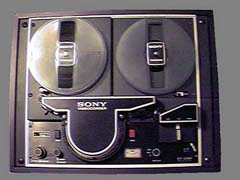
The CV 2000 was announced by Sony in Japan in October 1964. It was a 2-rotary head unit which used a half-inch tape, and was intended for the consumer market.
Prices
Sony Videocorder Net Price Schedule for 2000 Series May 1967
CV-2000D Videocorder with walnut base $695.00
CV-2000 Videocorder (portable) $730.00
TCV-2010 Videocorder with built in monitor/TV )portable) $995.00
TCV-2020 Videocorder with built in monitor/TV in Walnut case, with timer $1150.00
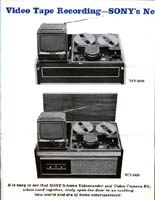

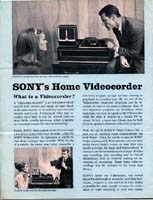
According to the SONY website, in 1964, a team led by Nobutoshi Kihara developed the CV-2000, which was marketed in 1965. These Videocorder decks, when used with a Sony receiver/ monitor record both the video and audio portion of any off-the-air TV channel on half-inch video tape. With the Sony TV camera (or any similarly designed camera) these decks will record "live" action. They can play back the recorded material through a monitor or TV receiver in both sight and sound.
There are two Sony decks with the same electrical and mechanical capabilities throughout. Both provide the basis of a TV recording studio for business or educational application. They employ the ingenious Sony alternate-field scan and repeat-field playback system, making it possible to operate the tape at a slow 7 1/2 ips. An hour of program material can be recorded on a 7-inch reel. Cost is less than $40, and the tape can be erased and used again and again.
Model CV-2000. The most portable video tape recorder ever designed, is housed in a sturdily-constructed carrying case with a durable leatherette finish. Weighing only 46 lbs., it can be carried easily from location to location.
Model CV-2000D. This economical deck is housed in a handsome walnut-finish case. Compact, it can be installed anywhere--even where space is limited.
These compact, lightweight decks make possible a wide range of applications. Using a Sony monitor and the VCK-2000 Sony Video Camera Ensemble (TV camera, tripod and microphone) "live" indoor and outdoor scenes--both sight and sound--can be recorded and played back instantly or stored for future use. This opens the way to a wide variety of applications in education, science and business for sales training, production training, surveillance, continuous monitoring of hazardous operations, dramatic and athletic instruction etc.
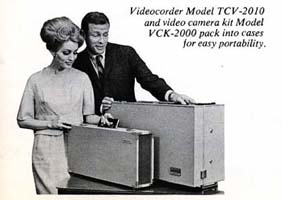
These decks are designed for use with the Sony receiver/monitors, the large-screen CVM-2300U or the port-able CVM-51UWP. Used with a branch cord, the Videocorder decks can be connected to more than one monitor, an important feature for large group presentations. The Sony TV Adapter makes it possible to employ standard TV receivers for off-the-air recording or playback.
An important feature of these units is tape interchange-ability. Any tape recorded on one Sony Videocorder can be played back on any other Sony Videocorder. For ex-ample, a recording made at company headquarters can be distributed to any division or branch where a Videocorder is available. Similarly, educational institutions can exchange tapes with other schools.
ELECTRONIC
Circuitry solid-state
Recording signal 2:1 interlaced composite signal based on American TV standards, including industrial sync.
Signal recording method Double-sideband FM recording
Horiz. Resolution Greater than 200 lines
Video signal-to-noise ratio Greater than 40db.
Video output 1-4V (P-P), sync negative, 75 ohms
Video input 1-3V (P-P), sync negative, 75 ohms
Camera input For Sony CVC-2000*
Microphone input-Low impedance, - 60db unbal., 600 ohms
Audio frequency range 80 to 10,000 Hz
Audio signal-to-noise Greater than 40db
Audio aux. Input High impedance, - 20db balanced
Audio output to line
For use with TV cameras other than Sony CVC-2000 refer lo Bulletin P.E.T.I.-2
GENERAL
Recording system Rotary two heads helical scanning
Servo system Electro-magnetic
Recording time 60 min. continuous (with V-32 tape, 2,370 ft.) 30 min. continuous (with V-31 tape, 1240 ft.)
Rewind/fast forward time Within 7 minutes
Motor 1 single-phase hysteresis synchronous
Audio-control head Stationary, two heads
Erase head Full track (EP-51-21)
Tape speed 7.5 ips
Tape ½”, Sony “V” series or equiv.
Meter Audio level, video level, AC line voltage
Operating position horizontal
Operating temperature 0-40 degrees C (32-104 degrees F)
Power req. &. Consumption 117 VAC, 60 Hz + 0.4, 80 watts
PHYSICAL
Dimensions 18 1/8 x 11 7/8 x 15 ¾” (CV-2000)
19 ¾ x 9 7/8 x 15 1/4" (CV-2000D)
Weight 46 lbs. (CV-2000); 42V2lbs. (CV-2000D)
Case Leatherette covered plywood (CV-2000); walnut finish (CV-2000D)
ACCESSORIES SUPPLIED
V-30, Sample Tape; RH-7V empty reel; Head cleaner set; Sony OL-1K lubricating oil; Splicing tape; 8-pin connector; 2-pin connector.
ACCESSORIES AND AUXILIARY EOUIPMENT
VCK-2000 Camera Ensemble To record "live" action (TV camera, microphone tripod, extension cables)
CVM-2300U 22-inch (measured diagonally) receiver/monitor To be used for viewing by large groups
CVM-51UWP 8-inch (measured diagonally) receiver/monitor To be used as TV receiver screen
CVO-1 Dust Cover Clear, provides access to controls when Videocorder is operating
CVO-2 Dust Cover Tinted, permits operation of Videocorder, but not controls
V-31 Video Tape 7-inch reel, ½ hr., 1,240 ft.
V-32 Video Tape 7-inch reel, 1 hr., 2,370 ft
RH-7V Tape Reel 7-inch reel
VMC-Branch Cords (VMC-1, VMC-1B, VMC-1D, etc.) **To feed additional monitors
Refer to Technical Bulletin P.E.T.I.-3Summary
The CV 2000 is a ½" open-reel Videocorder announced by Sony in Japan in October 1964; it is described as a 2-rotary head recorder developed by a team led by Nobutoshi Kihara and marketed in 1965. Specifications note solid-state circuitry, recording times of 60 minutes continuous with V-32 tape (2,370 ft.) and 30 minutes with V-31 tape (1,240 ft.), and rewind/fast-forward within seven minutes. Supplied accessories include V-30 sample tape, RH-7V empty reel, head cleaner, Sony OL-1K oil, splicing tape and connectors; auxiliary equipment includes VCK-2000 camera ensemble, CVM-2300U monitor and CVO-1 dust cover; Technical Bulletin P.E.T.I.-3 is referenced.
Submit a change or correction
Last modified 18 September 2026